







FICHA DEL JUEGO
Precio: 0 €
 Comprando este juego podrás ganar OcaPoints.
 Edición: 







En la Tienda MasQueOca existen varios estados en los que puede estar un juego:
| En stock: el juego está actualmente en nuestros almacenes y disponible para su envío. (*) | Últimas unidades: tenemos en stock unas pocas unidades del juego bien por tratarse de una oferta especial en precio o porque el editor ya ha agotado las unidades de las que disponía y de momento no tiene previsto hacer una reimpresión. (**) |
|---|---|
| Precompra: el juego tiene una fecha aproximada de recepción, está indicada en la ficha del juego, esta fecha no es fija ni vinculante y pudiera adelantarse o atrasarse por causas ajenas a nuestra voluntad. Se procederá al envío del pedido en cuanto lo recibamos de acuerdo a las reglas de Pedidos en Precompra. ¡Atención, las precompras no son reembolsables y se consideran como productos encargados específicamente por el cliente!
P500: el juego no ha sido todavía editado, pero se puede reservar sin compromiso para poder tenerlo asegurado cuando se edite. No es posible adquirirlo todavía pero sí reservarlo. Cuando el juego alcance el número de reservas necesarias o por decisión editorial pasará al estado Precompra. |
Disponible Bajo Demanda: el juego no está en este momento en nuestros almacenes, pero en principio estamos esperando su reposición por parte del proveedor. El tiempo de reposición aproximado para un juego nacional es de 1 semana y para un juego de importación suele ser de 3/4 semanas, pudiera ser que recibamos la reposición antes o que en el caso de la importación se demore por causas ajenas a nuestra voluntad. (***) ¡Atención, las compras bajo demanda de juegos de importación no son reembolsables! Pero si un juego no estuviera disponible en el editor, en el momento en que tuviésemos constancia te avisaríamos para que pueda solicitar su cambio o anulación. |
| Pendiente de Primera Edición: el juego no ha sido todavía editado, pero se puede reservar sin compromiso para poder tenerlo asegurado cuando se edite. No es posible adquirirlo todavía pero sí reservarlo. Cuando tengamos una fecha aproximada de recepción el juego pasará al estado Precompra. | Agotado / Pendiente de Reedición: el juego se encuentra agotado por el fabricante y está preparando una reedición. El juego se puede reservar sin compromiso para poder recibir la información del mismo en el momento que se reedite. No es posible adquirirlo todavía pero sí reservarlo. Cuando tengamos una fecha de recepción el juego pasará a Precompra. |
| Oportunidades: el juego está en stock en unidades limitadas. Las Oportunidades son juegos que o bien han sufrido algún desperfecto en la caja o bien han sido abiertos por alguna razón (comprobaciones de control de calidad, etc), pero que su contenido está perfecto. Es decir, son juegos que contienen todo lo necesario para poder jugarlo. No se remitirán fotos específicas del estado de las cajas, a todos los efectos se debe considerar como si se comprase el juego sin caja y sin inserto, aunque la gran mayoría de las veces son desperfectos sin importancia. Estos juegos, dada la naturaleza de los mismos, no admiten cambios ni devoluciones. | Chollos: el juego está en stock en unidades limitadas. Los chollos son juegos nuevos a estrenar que ofrecemos a precios especiales. La oferta está limitada en el tiempo y a las unidades que se pongan en oferta, una vez se retiren de la sección de Chollos su precio volverá a ser el estándar. Estos juegos, dada la naturaleza de los mismos, no admiten cambios ni devoluciones. |
| Descatalogado: el juego ha sido descatalogado por el fabricante por lo que en principio no se espera ninguna reimpresión. No obstante, en contadas ocasiones, un fabricante decide volver a imprimir un juego. No es posible adquirir el juego, pero sí reservarlo. Si tenemos constancia de una reimpresión y una fecha aproximada de recepción, pasará a Precompra. | |
| Reserva Vinculante: la Reserva Vinculante permite reservar anticipadamente un juego mediante el pago de un importe inicial, que será descontado del precio final del producto reservado cuando se habilite su adquisición definitiva. Esta reserva da derecho al cliente a acceder de forma anticipada a la precompra del juego objeto de la reserva, en condiciones más ventajosas de precio, así como a los juegos, expansiones o add-ons relacionados con dicho producto, cuando estén disponibles. El importe abonado está vinculado exclusivamente al juego reservado. En caso de que el cliente no complete posteriormente la adquisición del producto, dicho importe no será reembolsable ni podrá aplicarse a otros juegos, artículos o pedidos. Por su naturaleza especial, la Reserva Vinculante no permite añadir al pedido otros productos ajenos a la misma, solo admite una unidad por pedido, no permite el uso de cupones descuento y no genera OcaPoints. La realización de la Reserva Vinculante supone la aceptación expresa de estas condiciones particulares. | |
(**) Salvo que en el mismo momento de realizar la compra se realice en paralelo otra compra que agote las unidades, dada esta situación el juego pasará a disponible bajo demanda a precio normal o a descatalogado y se lo comunicaríamos por correo electrónico.
(***) Salvo que al solicitar la reposición al editor nos comunique que el juego esté descatalogado o pendiente de reimpresión. Lo que se comunicará por correo electrónico en cuanto tengamos conocimiento.
|
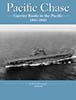
Pacific Chase: Carrier Raids in the Pacific, 1941-1942 The PBY’s engines render anything but a shout undecipherable, intensifying the isolation Chester Nimitz feels as he eyes the harbor below. The airplane circles as its crew confirms landing instructions, giving the Admiral more time to observe the impressive spread of oil swamping the listing ships and those upturned. The reports were dire, but seeing the wreckage of the Pacific Fleet’s battleships with his own eyes defies explanation. It is Christmas morning 1941, and the United States has been at war for two weeks. Appointed the new commander of that wrecked fleet, Admiral Nimitz and his staff are forced to set aside the principle of decisive war via battleship that governed pre-war planning. Strong-arm agreements between Britain, Japan, and the United States in 1922 and 1930 established an advantage in battleship tonnage for the U.S., but in an instant, Japan inverted that ratio. Her navy’s two-hour air raid on December 7 saw to that. The PBY banks, affording a view of the empty carrier berths on the north side of Ford Island. Nimitz thinks of the four aircraft carriers at his disposal, dispersed and on assignment. With the army’s retreat from the Philippines, he will have to keep them out of harm’s way if the United States will maintain presence in the Pacific, buying time for industry to replace what has been lost. More troubling is knowing he must entrust the decisive battle to their flight decks, should Japan force it upon him. Pacific Chase presents the naval campaigns fought in the Eastern Pacific between the surface fleets of the United States and Imperial Japan from December 1941 to September the following year. It utilizes a system of trajectories to model the fog of war that bedeviled the commands during this period, inviting players to arrange trajectory lines across the shared game board, each line representing a task force’s path of travel. Without resorting to dummy blocks, hidden movement, or a double-blind system requiring a referee or app, players experience the uncertainty endemic to this period of air-naval warfare. This system also has the benefit of allowing the game to be played solitaire, and to be played quickly. The game is operational in scope, but strategic concerns shape the battlefield. The game utilizes a system of changing Objective Panels that allow each player’s goals to gradually, and sometimes dramatically, morph over the course of a scenario and campaign. As Task Forces perform actions, the results may alter objectives or change opportunities to call on reinforcements. For the Japanese player, the construction of a robust defense perimeter of island bases governs their set of objectives, while the U.S. player will be keen to interrupt that strategy without risking a disastrous loss of naval assets. The Op Panel system allows players to make key choices operationally while the game maintains broad historical parameters strategically. The game chronicles Imperial Japan’s outward push to Wake atoll, Midway, the Aleutians, and especially the Solomons and New Guinea. The Americans sally forth with what assets they still have, performing small and sometimes substantial raids to distract or hamper Japanese operations, or mount an outright stand. Scenarios encompass the raid on Pearl Harbor that opened hostilities and those that followed: operations to capture Wake, Rabaul, Port Moresby, Midway, and the Aleutians, as well as the summer initiative by the United States and its Allies to secure an airfield in Guadalcanal. There are options and decisions to make. The Japanese player might prefer to skip the raid on Pearl Harbor and focus their energy elsewhere, affording their adversary the opportunity to utilize their impressive fleet of battleships. Or perhaps they will choose to hunt American aircraft carriers, ignoring the battleships. What will the American player do in reply? The game is organized into scenarios large and small, for two players and for solitaire as either the Imperial Japanese or the United States player. Scenarios cover one or two months of operations and put into play a vast stretch of territory from Hawai’i to the Japanese Home Islands, the Aleutians to the tip of Australia. Several mini-map scenarios focus on a single action, such as the invasion of Wake for example, the Battle of Savo Island, or Battle of the Coral Sea, and are played without Op Panels and on an 8.5” x 11” inset map (six inset maps are included in the game). At the other extreme, the campaign strings together operations and uses all twenty-four Op Panels, spanning the crucial first nine months of the Pacific War, and offers players the entire map. The game features battleships, aircraft carriers, cruisers, troop ships, and destroyer squadrons. Air bases are vital, as Imperial Japan strives to build a wall to keep the growing American juggernaut at a distance. Operations during the Campaign Game and stand-alone historical scenarios each take 1-2 hours to play. Will the Japanese player do what the Kido Butai never managed, trap and annihilate U.S. carriers? Or will Admiral Nimitz manage to elude that fate while keeping the Imperial Japanese Navy from realizing its strategic goals? Trajectories Imagine Admiral Nagumo aboard the aircraft carrier Akagi as its task force steams for Midway in the first week of June 1942. With orders to raid the U.S. airbase in preparation for an invasion, he dare not break radio silence. This means the Admiral of the Combined Fleet does not know the Akagi’s whereabouts, only its point of embarkation and its intended destination. More importantly, he can’t know the precise location of the American aircraft carriers either. Last reported in Hawai’i, it is hoped the attack on the airbase will draw them out. Meanwhile, Admiral Nimitz has information placing the Japanese task force on its way to Midway and sends a U.S. carrier force to intercept. Once that task force exits Pearl Harbor, adhering to a protocol of radio silence too, their exact location will remain a mystery. Only when one task force makes contact with the enemy, and aircraft launch to strike, will information be forthcoming. Only then will the picture clarify. In this game system, each task force is represented either as a point or a line, a station or a trajectory. As a point, the task force’s location is fairly well-known, but as a line it only presents fuzzy information. Its location is somewhere between the ends of the line. As a line, a task force is harder to bring to battle. A trajectory indicates a probable course. The ships that comprise that task force are kept off map on a Task Force Display, and they are understood to be in a group somewhere between the two ends of the trajectory. To bring those ships into port, or to battle, the trajectory must be reduced to a point. There are no turns in Pacific Chase. While a player has the Initiative, they activate task forces to perform actions and continue doing so until they lose the Initiative. The game swings back and forth until the scenario or operation is complete, each player striving to bring the enemy to battle under advantageous circumstances. Typical of the historical events depicted by the game, battles tend to be fleeting and short, interspersed with searches, evasive maneuvers, more air attacks, shore bombardments, perhaps a surface engagement, invasions, and attempts to break away to safety. Players conduct actions to “clarify” lines into points, thereby determining where battles happen or ships slip into port. Atlantic Chase Players Those familiar with the previous game in the Intercept series will recognize the trajectory system and the actions menu. The Air Strike action has been elaborated into a two-step Air Intercept event in Pacific Chase, accounting for the increased scale of air operations in the Pacific theater. Airbases are now capable of performing actions too, and they can be bombarded and invaded via an elaborated Engage action. Much of the game hinges on them. The initiative system has been changed to accommodate a less capricious swing of fate, also allowing for less predictable weather checks and more restricted use of submarine forces (Stealth Zones instead of U-Boat forces). The Initiative Mechanism also ties to the Operation Panel system, the most significant change to the game. Atlantic Chase depicted discrete sorties by German surface raiders, allowing a clear beginning and end to operations, but Pacific Chase must treat more fluid and continuous action as one operation ebbs and another initiates with little pause between. Components: • One 22" x 34" map board (color, single-sided) • Three 8.5" x 11" inset map boards (color, double-sided) • Two 8.5" x 11" Task Force display boards • One 8.5" x 15" Battle board (double-sided) • Two full sheets of 5/8" & 1/2" counters • One half sheet of 1/2" counters • Sixteen 10mm cylinders • One hundred and sixty 1" x 0.2" x0.2" sticks • Three 8.5" x 17" double-sided player aids • One 8.5" x 11" double-sided player aid • One 74 page Rulebook • One 16 page Advanced Rulebook • One 52 page 2-Player Scenario Book • One 68 page IJ Solo Scenario Book • One 74 page US Solo Scenario Book • One 64 page Tutorial Book • Six 6-sided dice • 3" Box
|